
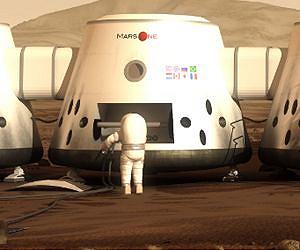
200,000 people from 140 countries have applied for a one-way ticket to Mars. The applicants agreed to stay on the Red Planet for the rest of their lives and be filmed for a reality TV program, according to the company behind the mission, Mars One.
David Mimoun, an Associate Professor at Institut Superieur de l'Aeronautique et de l'Espace, (French Superior Institute of Aerospace) for the SUPAERO Engineering Degree, shared his opinion on this topic with the Voice of Russia. He is currently SEIS instrument project scientist at Jet Propulsion Laboratory in Pasadena California for the InSight mission to Mars.
Is Mars One mission a revolutionary project, in your professional view?
Yes, as a matter of fact it is a kind of revolutionary project because the point is that it is a one way ticket. Usually, in most of the missions you take people to space and you want to take them back. And this is revolutionary in the sense that there is no return ticket. There is a new settlement and that's it, you won't get back. So, that is a new way of thinking.
So far, as we understand, 200,000 people expressed their willingness to participate in it. Is it surprising?
Well, yes and no. I think the challenge of starting a new life and the spirit of exploration is always great. This is a really new adventure. On the other hand this is kind of surprising because the risk that they are taking is very high. There is no return ticket, as I said. So, that's kind of surprising.
What are gravity specifications on Mars?
On Mars the gravity is about 1/3 of the gravity that we have on Earth. So, it means that you will have to sustain during a long time a reduced gravity and maybe your bones will become weaker. So, you can jump higher but your bones will get weaker. And if you've got a baby on Mars, then it might come to some issues with its development. We know from the recent experiments for instance that people can survive long time in a reduced gravity environment, but you have to take some medical precautions in order to do that.
I can hardly imagine women's labour on Mars. What challenges apart from giving birth to a child could the first Mars immigrants face on that surface of the red planet?
Yes, I don't know what it would look like, I'm not a physician. But that would be certainly challenging, not only giving birth, but growing and having a good development is certainly one of the challenges. In addition to that there will be a high level of radiation. In orbit, for instance, in the Mir station you are protected by the Earth. There you won't be protected by any magnetic field such as we have. So, that is also an issue with respect to babies.
How could they potentially be addressed?
I think there are several kinds of challenges. In the first place there are factual challenges. The facilities, the accommodation – it will be a reduced space, they will be living in small quarters, small places where they can breathe. Then, there will be challenges that they will rely on mechanical systems for the life support. They will rely on food that they will have taken with them before they are able to grow crops and something like that. And they will also rely on their own skills for the all related issues. So, that is first factual thing.
I think, with respect to factual things you can always foresee something. I mean, you can double the system, you can send robots in advance, you can try as much as possible to mitigate this. But there will be also some psychological things, because there is no way back, you are far away from your family and your friends, and Earth, and you will not see anyone from your previous life. So, that is kind of a challenge, I would say.
Source: Voice of Russia
