
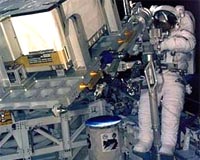
Japan's Kibo module, the main component of which is being carried to the International Space Station by NASA's Discovery shuttle, marks a major expansion of the station's research capacity.
When completed, the 2.8-billion-dollar science lab will provide room for four astronauts to carry out experiments in space medicine, biology and biotechnology, material production, and communications, both in a pressurized environment and completely exposed to space.
Discovery is carrying Kibo's huge central unit, the Japanese pressurized module (JPM). It is the second of three shuttle trips to ferry up the lab's components.
The unit will become the largest single room at the ISS, measuring 11.2 meters (36.7 feet) long, compared to NASA's Destiny module's 8.5 meters and the 6.8 meter Columbus unit of the European Space Agency.
At 14.8 tonnes (32,600 pounds), the JPM weighs so much that its key internal components — banks of system and experiment units, or racks — were pulled out and ferried up to the ISS on the March 2008 shuttle mission.
Kibo, or "Hope" in Japanese, has five key components:
– the JPM, where the main research is conducted and where the entire unit can be controlled;
– the logistics module, built to carry up the JPM's internal equipment from Earth and then and serve as a storage facility;
– the remote manipulator system, a 10 meter robotic arm, with a small 2.2 meter extension, for moving equipment and materials around Kibo;
– the exposed facility (EF), a shelf-like section to carry out experiments completely exposed to the space environment; and
– the experiment logistics module, exposed section (ELM-ES), which carries experiment payloads for the EF.
The Japanese contribution to the ISS is being ferried up piece by piece over three shuttle missions.
The March 2008 shuttle carried up the logistics module and the JPM's internal racks, and the current mission will carry the JPM and the robotic arm. A flight scheduled for 2009 will deliver the exposed facility and the ELM-ES.
When fully installed Kibo will be jointly monitored from the Japan Aerospace Exploration Agency's Tsukuba facility and NASA Mission Control in Houston, Texas.
