
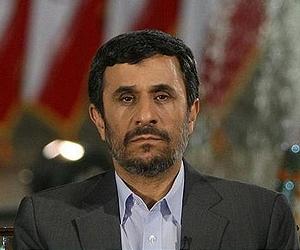
Iran is ready to resume nuclear talks with the world powers but will press ahead with its atomic activities including uranium enrichment, President Mahmoud Ahmadinejad said on Tuesday.
"They want to negotiate again. Let's negotiate for understanding and cooperation… but until they change their arrogant approach to one of cooperation, verbal clashes via the media will continue," he said.
The so-called 5+1 group — the UN Security Council veto-wielding United States, Russia, Britain, France and China, and non-permanent member Germany — have been negotiating with Iran for years over its controversial nuclear programme.
The two sides met in Geneva in December and in Istanbul in January, but both meetings ended without progress.
"We are conducting our activities legally. We have had the most cooperation with the agency," he said of UN nuclear watchdog the International Atomic Energy Agency (IAEA).
"The nuclear issue is an excuse. The real issue is that the West is against our independence," Ahmadinejad added.
He said that Tehran's nuclear activities "are progressing rapidly. Centrifuges are working. New designs are under way. Our research is moving forward. We even have 20 percent enrichment which we didn't have before."
Asked whether Iran would suspend its uranium enrichment programme, he replied: "No."
He criticised statements by IAEA chief Yukiya Amano on Monday that the agency had "received new information" regarding Iran's nuclear activities.
Amano said the IAEA "has received further information related to possible past or current undisclosed nuclear-related activities that seem to point to the existence of possible military dimensions to Iran's nuclear programme."
Ahmadinejad said: "How is it that Mr Amano closes his eyes… to radiation?" after Japan's Nuclear and Industrial Safety Agency said 770,000 terabecquerels of radiation had escaped into the atmosphere in the first week of the Fukushima accident, more than double its earlier estimate.
"Instead, under US direction, he writes something in a report in violation of the law and the IAEA statute," he asked.
"These claims have no legal standing and only tarnish the reputation of the agency," Ahmadinejad said.
"We we will carry on and cooperate with them as long as they act logically and with justice."
Many Western countries fear Iran seeks to acquire a nuclear military capacity under the guise of its civilian atomic programme, a charge Tehran has repeatedly denied.
The UN Security Council has condemned Iran's atomic activities in six resolutions, including four sets of economic and political sanctions, despite continuing IAEA inspections of Iranian installations.
The main target of the sanctions is Iran's uranium enrichment programme, which can produce either fuel for a nuclear reactor or the fissile material for an atomic warhead.
