
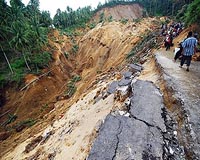
Indonesian authorities declared as mass graves Tuesday seven villages destroyed by earthquake-triggered landslides, as they called off the search for over 200 people believed buried.
The decision to cancel the search in villages obliterated by landslides caused by the huge 7.6-magnitude quake that struck Sumatra island on September 30 had been made in consultation with the local community, said Padang Pariaman district police chief Uden Kusumawijaya.
The disaster, which also devastated the nearby city of Padang, killed 809 people, according to the latest official death toll. The United Nations has said the disaster likely killed upwards of 1,100.
"There was an agreement to stop the search for victims buried in the landslide due to the earthquake. The community has consented," Kusumawijaya told reporters.
"The landslide areas are considered graves for those who are buried," he said.
A total of 225 people were believed to have been buried in the devastated hamlets, said Padang Pariaman district spokesman Syofrian.
"Of course there are some in the community who don't agree, but most do, so we've stopped the search for victims. It's very hard to find those victims who are still buried," he said.
About 100,000 homes were destroyed by the quake and entire villages were wiped out in landslides. An estimated 500,000 people were left homeless by the disaster.
earlier related report
UN aid appeal for Philippines falls 'tens of millions' short
A fund-raising effort to help millions displaced by two deadly cyclones in the Philippines has fallen 55 million dollars short, and more aid is needed, a UN official said Tuesday.
So far, only 19 million dollars had been committed from the 74 million dollars the United Nations requested in a "flash appeal" last week, said UN Under-Secretary-General for Humanitarian Affairs John Holmes.
That money is just for relief connected to Tropical Storm Ketsana which hit the Southeast Asian nation on September 26. But the United Nations will have to ask for more than the 74 million dollars initially requested after Tropical Storm Parma battered the country from October 3 to 10, said Holmes.
"We will revise it (the sum). We may need to increase it," Holmes told reporters.
"The crisis is by no means over. Indeed, the hard work is just starting," he said.
He would not specify how much money would be needed, saying both the UN and the government were still working together to assess the full damage from Ketsana and Parma.
The storms caused massive flooding in the capital Manila and surrounding areas, huge landslides in the northern mountains and left about 650 dead, civil defence officials said.
Holmes said raising aid and relief funds for this "double disaster" was made more complicated by global financial turmoil and a spate of other disasters in the region which also needed aid money.
Food, shelter and medical care are needed by the more than six million people who Manila said were displaced by the storms, he said.
The country also urgently needs to better prepare itself for more disasters, he added.
Among the threats were diseases that could be spawned by stagnant flood waters that still cover many towns.
"Clearly, there is a major risk of disease," said Holmes, calling for ways to remove the stagnant water rather than waiting for it to recede on its own.
UN resident coordinator Jacqueline Badcock said Holmes would be meeting with the world donor community in the coming days to see how to get more aid.
While the government was already looking at rebuilding, "we have to get through the immediate crisis situation first," she said.
Share This Article With Planet Earth
