
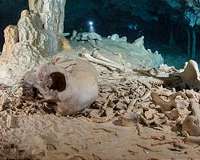
Analysis of a skeleton found in the Chan Hol cave near Tulum, Mexico suggests human settlement in the Americas occurred in the late Pleistocene era, according to a study published August 30, 2017 in the open-access journal PLOS ONE by Wolfgang Stinnesbeck from Universitat Heidelberg, Germany, and colleagues.
Scientists have long debated about when humans first settled in the Americas. While osteological evidence of early settlers is fragmentary, researchers have previously discovered and dated well-preserved prehistoric human skeletons in caves in Tulum in Southern Mexico.
To learn more about America's early settlers, Stinnesbeck and colleagues examined human skeletal remains found in the Chan Hol cave near Tulum. The researchers dated the skeleton by analyzing the Uranium, Carbon and Oxygen isotopes found in its bones and in the stalagmite which had grown through its pelvic bone.
The researchers' isotopic analysis dated the skeleton to ~13 k BP, or approximately 13,000 years before present. This finding suggests that the Chan Hol cave was accessed during the late Pleistocene, providing one of oldest examples of a human settler in the Americas.
While the researchers acknowledge that changes in climate over time may have influenced the dating of the skeleton, future research could potentially disentangle how climate impacted the Chan Hol archaeological record.
Farming, cheese, chewing changed human skull shape
The advent of farming, especially dairy products, had a small but significant effect on the shape of human skulls, according to a recently published study from anthropologists at UC Davis.
Humans who live by hunting and foraging wild foods have to put more effort into chewing than people living from farming, who eat a softer diet. Although previous studies have linked skull shape to agricu … read more
