
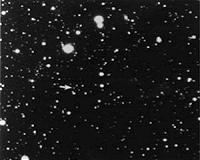
I'm an astronomer and I've been studying Pluto as a pinpoint of light for over 25 years. It will be so exciting to see this little white dot turn into a geologic world in a matter of weeks.
What can we learn by looking at tiny Pluto through a telescope? It turns out quite a bit. We've already identified and mapped some of the ices on its surface: nitrogen, methane, and carbon monoxide.
We've also learned that like Earth, Pluto should exhibit seasons, with growing and receding polar caps. And we have blurry maps of Pluto from telescopes, including some from the Hubble Space Telescope, show that frost patterns are changing on Pluto. Pluto also seems to be getting brighter and redder, which would happen if fresh, white-colored frost were uncovering a subsurface of older, reddish methane.
Looking at how stars dim as they pass behind Pluto, astronomers have seen its atmosphere double in the past two decades. We hope to see some of this exciting activity as we cruise past Pluto.
Our search for Pluto's secrets will not end in 2015. We will press on to learn more and more, and to answer the new questions uncovered by New Horizons.
A flyby cannot give a picture of Pluto through time. So using ground-based techniques in the years after the flyby, we will be looking for continuing volatile transport, and monitoring the presence of the various ices on the surface of Pluto.
We will also observe for a very special opportunity: in 2018, Pluto will become perfectly fully illuminated to an observer on Earth. We all know how our own Moon becomes very bright when it's full. This "opposition effect" implies that the Moon has a very fluffy texture, and we'll be looking closely to see if Pluto brightens like the Moon does.
