
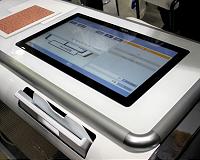
While the race to make better and faster 3D printers has consumed industry by storm, a more facile approach has just arrived, and may force a re-think of the revolutionary technology. Welcome to the world of 2.5D printing.
Casio Computer, better known for its calculators and wristwatches, is at the forefront of 2.5D, introducing its hardware for the first time in Japan at the 24th 3D and Virtual Reality Expo held in late June at Odaiba, Tokyo.
What's the difference between 3D and 2.5D? While 3D prints a design layer by layer by string to form a finished three-dimensional object, Casio's Thermal Distend (TD) technology allows for the construction of raised, contoured images from a two-dimensional plane – much like geographical maps that reflect height and depth as well as distance.
The key to the technology is a special paper medium, which contains a base layer, thermally-expandable plastic microcapsules in the middle, and a color receptive layer on top. First, the desired colors and designs are imprinted by inkjet, after which the paper is heated by halogen lamp, which induces the plastic to bloat out to specified dimensions.
Once the microcapsules harden, the process is complete, usually within a few minutes. The company's prototype printer supports A4 and A3 paper sizes, and virtually all standard colors.
The new platform enables a variety of applications, including more tactile and effective teaching aids, where students can learn more about the feel and dimension of the physical world. The company sees a range of uses for instructing the blind and visually impaired, as well as in creating and recreating art.
Speed and cost savings are two big advantages that 2.5D enjoys over 3D printing. "In nearly all modern manufacturing processes, designs go from idea to formula to sketch and finally to 3D mockup," explains Hideaki Terada, executive director at Casio's digital art division.
"Putting together a 3D mockup for a simple car door handle at a big car maker can take a week; a 2.5D printer can do a reasonably good job in just a day."
Samples of various textures provided at the expo, including coffee beans, simulated leather, and other shapes seemed to illustrate the time- and cost effectiveness of the technology. For internal company presentations of preliminary ideas, 2.5D may not be perfect, but does offer a practical alternative to 3D versions until polished designs are ready for final approval.
Automakers, appliance makers, apparel and construction firms have showed strong interest in Casio's new printer, says Mr. Terada, noting that the firm's 2.5D development unit is only a year old, and is still learning much about the potential market as inquiries pour in.
As for cost, he puts the likely price for the company's 2.5D unit, which measures about as big as a two-person work desk, in the 4-5 million yen range once all is settled. That compares with industrial-strength 3D printers that typically run up to 20 times as much. Officially, however, Casio has not yet decided to commercialize its machine.
