
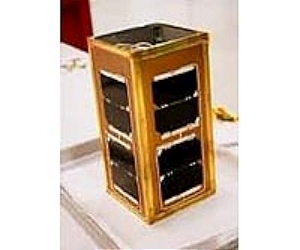
The final satellite launched in the 30-year lifetime of the shuttle program, the latest in a series of nanosatellites built by The Aerospace Corporation with support from the Space and Missile Systems Center's Development Planning Directorate (SMC/XR), was deployed from the Space Shuttle Atlantis (STS-135) on Wednesday, June 20, at 12:49 a.m. Pacific Daylight Time (PDT).
Weighing just under four kilograms and measuring 5 x 5 x 10 inches, the Pico Satellite Solar Cell Testbed 2 (PSSC2) will serve as low cost risk reduction for the upcoming SMC Space Environmental Monitoring Nanosat Experiment (SENSE) because it contains the Aerospace Corporation's Compact Total Electron Content Sensor (CTECS) that characterizes the ionosphere by measurement of the occultation of GPS signals – a precursor of an instrument with the same function on SENSE.
PSSC2 also carries over the task from PSSC1 of characterizing the performance of advanced solar cells from Spectrolab and Emcore.
Finally, PSSC2 again hosts an upgraded Miniature Tracking Vehicle payload, similar to that flown on PSSC1 that will serve as an orbiting reference for ground tracking systems.
Fabricated and delivered in six months due to the sudden NASA decision to fly STS-135, this flight opportunity and safety process were expertly managed at the DOD Space Test Program's Human Space Flight Payloads Office.
The PSSC2 was the last satellite deployed by STS-135, and its multiple megapixel cameras also took the final on-orbit photos of the shuttle. NASA broadcast images taken of the MTV during its deployment.
The PSSC2 nanosatellite, the 12th miniature satellite launched by Aerospace, will be controlled using the primary ground station at Aerospace and an Internet-based ground station network, consisting of two additional antennas in U.S. territories.
Two onboard GPS receivers will provide accurate time and position information to facilitate analyses of tracking errors.
The Space Shuttle Atlantis successful touched down on Thursday, July 21, at 2:56 a.m. PDT.
