
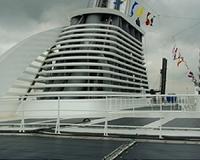
Three new ships slated for the fleet for Walt Disney Parks and Resorts will be powered by liquefied natural gas, the company's chairman said.
"All ship names, design plans and itineraries are still in development, with each of the ships expected to have their own unique experiences," the company announced on Saturday. "The three new ships will be powered by clean-burning liquefied natural gas and be the same size — approximately 135,000 gross tons with about 1,250 guest staterooms planned — which is slightly larger than the newest Disney Cruise Line ships, the Disney Dream and Disney Fantasy."
The marine fuels sector is emerging as a niche consumer of LNG, a form of natural gas chilled to a liquid. Last week, French energy company Total said it signed a "landmark" agreement with regional ferry company, Brittany Ferries, for LNG as a fuel source. Brittany Ferries ordered its first ferry ever chartered for regional waters in June, which is slated for service in 2019.
For the maritime shipping industry, LNG as a fuel source is transformative given the quest to cap emissions of nitrogen oxide, carbon dioxide and other harmful greenhouse gas emissions. Cruise line Carnival Corp. last year became the first company of its kind to power vessels with LNG. The company starting in 2019 will start sourcing LNG from the portfolio of Royal Dutch Shell.
Carnival said the agreement was part of a green initiative meant to reduce its environmental footprint.
Bob Chapek, the chairman of Walt Disney Parks and Resorts, said the three vessels add to an existing, and expanding, fleet and should be at sea by 2023 at the latest.
"By the time all three new ships are sailing, we'll have nearly doubled the size of our existing fleet," he said in a statement.
Spilt crude oil has repeatedly polluted and even destroyed marine ecosystems. An effective measure would be to remove spilt oil slicks by absorption into a separable solid phase. As Indian scientists now report in the journal Angewandte Chemie, congelation of the oil to a rigid gel within impregnated cellulose and scooping the particles out is possible.
Marine oil spills are disasters that … read more
