
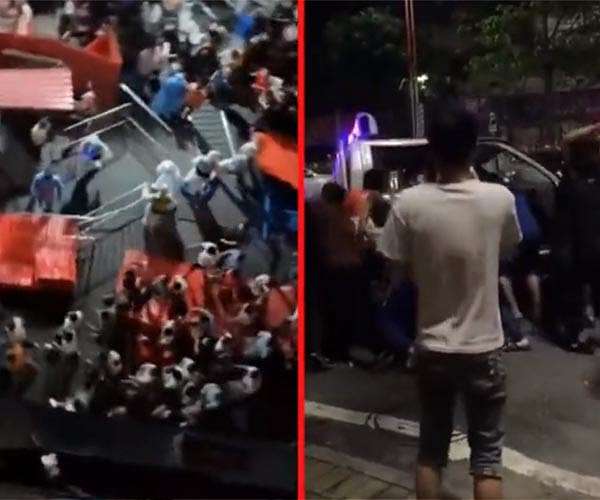
Clashes broke out between police and protesters in a southern Chinese city, part of a wave of Covid lockdown-sparked demonstrations across the country that have morphed into demands for political freedoms.
China's top security body warned late on Tuesday night that authorities would "crack down" following the protests, which are the most widespread since pro-democracy rallies in 1989 that were crushed with deadly force.
The demonstrations erupted over the weekend across major cities, including Beijing and Shanghai, with China's vast security apparatus moving swiftly to smother any further unrest.
But new clashes broke out in China's southern city of Guangzhou on Tuesday night and into Wednesday, according to witnesses and social media footage verified by AFP.
Security personnel in hazmat suits formed ranks shoulder-to-shoulder, taking cover under see-through riot shields, to make their way down a street in the southern city's Haizhu district as glass smashed around them, videos posted on social media showed.
In the footage people could be heard screaming and shouting, with orange and blue barricades strewn across the ground.
People are seen throwing objects at police, and later nearly a dozen men are filmed being taken away with their hands bound with cable ties.
A Guangzhou resident surnamed Chen told AFP on Wednesday that he had seen around 100 police officers converge on Houjiao village in Haizhu district and arrest at least three men on Tuesday night.
Some students at Guangzhou's universities said they were forced out of their dormitories overnight Wednesday, according to social media posts, as a growing number of universities nationwide ordered students home in the wake of campus demonstrations.
Multiple Guangzhou districts lifted restrictions on some or all locked-down neighbourhoods Wednesday afternoon, according to government announcements.
– 'Sign of weakness' –
US Secretary of State Antony Blinken, asked about the protests in an interview with NBC News, said that people in every country should be able to "make known their frustration" through peaceful protests.
"In any country where we see that happening and then we see the government take massive repressive action to stop it, that's not a sign of strength, that's a sign of weakness," Blinken said.
Anger over China's zero-Covid policy — which involves lockdowns of huge numbers of people and has strangled the economy — has been the trigger for the protests.
A deadly fire last week in Urumqi, the capital of the northwestern region of Xinjiang, was the catalyst for the outrage, with people blaming Covid curbs for trapping victims inside the burning building.
But demonstrators have also demanded wider political reforms, with some even calling for President Xi Jinping to stand down.
China's strict control of information and continued travel curbs have made verifying protester numbers across the vast country very challenging.
However, the widespread rallies seen over the weekend are exceptionally rare in China.
The 1989 pro-democracy protests ended in bloodshed when the military moved in, most famously in Beijing's Tiananmen Square and surrounding areas.
And the Wednesday news of the death of former Chinese leader Jiang Zemin — who came to power just after Tiananmen — saw state media emphasise his role in that crackdown.
"During the serious political turmoil in China in the spring and summer of 1989, Comrade Jiang Zemin supported and implemented the correct decision of the Party Central Committee to oppose unrest," state broadcaster CCTV said.
Some internet users used Jiang's death to juxtapose the more liberal 1990s with rule under Xi, China's most hardline ruler in decades.
"The Jiang era, while not the most prosperous era, was a more tolerant one," one Weibo user wrote.
Signalling its zero-tolerance approach to the protests, China's top security body on Tuesday called for a "crackdown" on what it described as "hostile forces".
The warning came after a heavy police presence across Beijing and Shanghai on Tuesday appeared to have quelled protests in those cities.
– 'Give me liberty' –
Some rallies did go ahead elsewhere on Monday and Tuesday, however.
At Hong Kong's oldest university, over a dozen people led the crowd Tuesday in chanting slogans such as "give me liberty or give me death".
"We are not foreign forces, we are Chinese citizens. China should have different voices," one woman shouted, while another held a placard mourning victims of the Urumqi fire.
In response, the semi-autonomous city's security chief warned Wednesday that protesters may be falling afoul of the territory's national security law, imposed in 2020 by Beijing.
In Hangzhou, just over 170 kilometres (105 miles) southwest of Shanghai, there was heavy security and sporadic protests in the city's downtown on Monday night.
The latest unrest has drawn global attention, with solidarity protests springing up from Melbourne to Washington.
And while China's leaders are committed to zero-Covid, there have been some signs that central authorities may be seeking a path out of the rigid policy.
China's National Health Commission announced Tuesday a renewed effort to expand low vaccination rates among the elderly — long seen as a key obstacle to relaxing the measures.
Hong Kong security chief warns against supporting China protests
Hong Kong (AFP) Nov 30, 2022 –
Hong Kong's security chief said he saw indications of a "colour revolution" at events held in solidarity with Chinese protesters and warned Wednesday they may violate the city's national security law.
Rare demonstrations on the mainland calling for an end to Covid-19 lockdowns and greater political freedoms have sparked a series of small public gatherings in Hong Kong since Sunday, including at university campuses and in the financial district.
Once an outspoken enclave in China, Hong Kong has quietened since Beijing imposed a national security law, a year after huge and sometimes violent protests in 2019.
Secretary for Security Chris Tang said Wednesday that some in Hong Kong had used the solidarity events to "incite against the central government".
"I noticed some early signs of another colour revolution," he said, using a euphemism favoured by Beijing and other authoritarian governments to describe allegedly foreign-backed protests.
"We can see some of the familiar faces that actively [participated] in the illegal acts of 2019," Tang told reporters, adding that the latest gatherings were "highly organised" and made use of anti-China social media platforms.
Solidarity events in Hong Kong have drawn dozens of attendees, who have mirrored protest tactics used in mainland China, such as holding blank pieces of paper.
But Tang said other signs bore words such as "revolution" and "autocracy" or called for leaders to step down, and warned these may "contravene the national security law".
"Many people say nothing will happen if you just hold a piece of paper… but they are deliberately downplaying the severity," Tang said.
"Their intent is to subvert the regime."
Subversion is one of four national security offences, which can be punished with a maximum of life in prison.
No one in Hong Kong has been arrested over the recent protests, but police have taken some participants' names.
Political dissent and mass assemblies in Hong Kong have largely disappeared or been forced underground since the national security law came into force in 2020, while large gatherings in public have been banned under coronavirus pandemic restrictions.
The recent solidarity events at two universities drew both local and mainland Chinese students, with participants chanting: "We are not foreign forces, we are Chinese citizens."
