
Six British academic institutions will join a U.S.-led search for answers on the early universe.
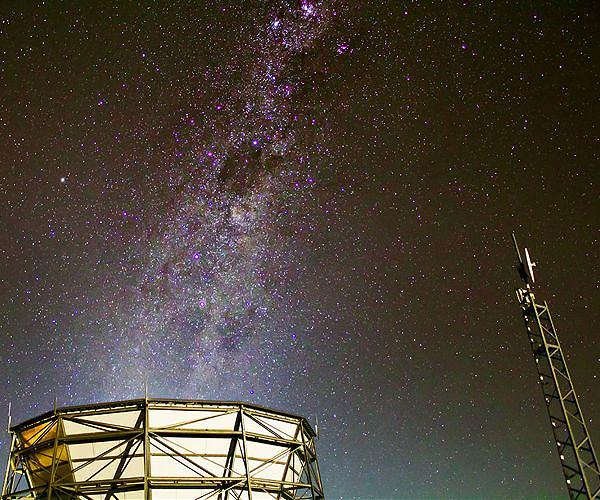
The project brings together 85 institutions from 13 countries to analyze data from the Simons Observatory, a series of telescopes 3.2 miles above Chile's Atacama desert. The observatory has three instruments that are designed to measure cosmic microwave background, the heat and radiation that was produced in the moments following the Big Bang.
CMB radiation was first theorized in 1948 by Ralph Alpher and Robert Herman, and first detected in the 1964 when the energy released by the birth of the universe, which took billions of years to reach Earth, was clearly detected by scientists.
Since then, CMB has been used as a window into the early universe.
"Tiny fluctuations in the CMB radiation tell us about the origins, content and evolution of the universe and how all the structures that we see in the night sky today started," Professor Erminia Calabrese of the School of Physics and Astronomy in Cardiff told the Guardian.
Scientists theorize that the small fluctuations in CMB can shed light on the formation of stars and galaxies. They also hope that studying the background energy can shed light on dark matter, the mysterious heavy matter that is thought to affect the movement of galaxies and to make up the majority of matter in the universe.
The University of Manchester will lead the British side of the project and will be designing and testing one of two new telescope receivers that will be installed at the observatory.
